In the Office, On a Call: The Strange New Reality of SF's Remote-First Workforce
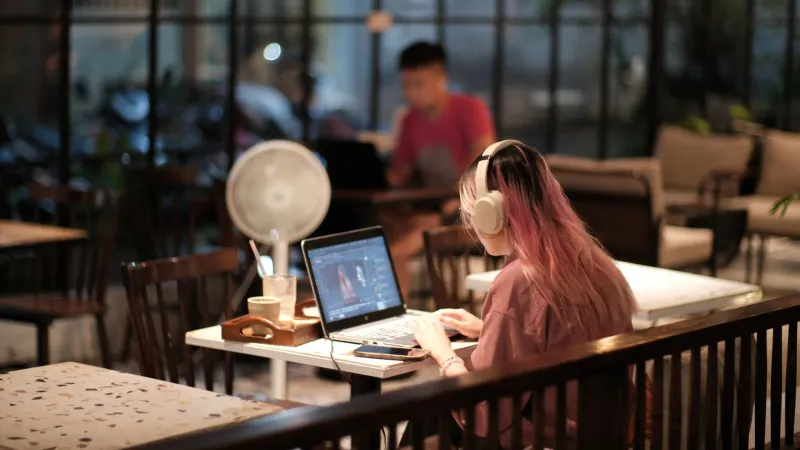
Let's paint a picture. It's 10am on a Tuesday in the Mission. A mid-level engineer at a Series B startup is sitting at a marble counter in a packed café, laptop open, AirPods in, nodding at a screen. Three feet to her left, a product designer is doing the same thing — different company, different Zoom, same general vibe. Neither of them has been to their company's physical office in two weeks. Both of them technically live in San Francisco.
This is the quiet contradiction at the heart of the city's supposed tech revival. The lease signings are up. The headcount announcements are back. But the in-person collaboration that once defined SF's startup culture? It's still somewhere between optional and theoretical for a huge chunk of the workforce.
The 'Return to Office' That Wasn't
If you read the headlines from the past 18 months, you'd be forgiven for thinking San Francisco had pulled off some kind of full tech resurrection. And in some measurable ways, it has. Foot traffic in SoMa is recovering. Startup event calendars are actually full again. The vibe, as people keep saying, has shifted.
But there's a gap between the narrative and the daily reality for a lot of people in the industry. Many of the engineers, designers, and founders who never actually left the Bay Area — or who moved back after a pandemic-era escape — are still working in ways that look almost identical to 2021. Remote-first habits didn't evaporate when companies started signing new office leases.
According to multiple conversations with SF-based tech workers, many describe their relationship with their company's physical space as "when it makes sense" — which, in practice, often means never. The return-to-office mandates that made headlines at big tech companies haven't uniformly trickled down to the startup world, where flexibility is still a recruiting chip nobody wants to give up.
The Talent Calculation
Here's the part that gets interesting from a community standpoint: the people least likely to be in the office tend to be the most senior and most sought-after. Staff engineers. Principal designers. Founders who've already built one thing and are quietly building the next. These are the people startups are desperate to attract — and these are often the people with the most leverage to define their own working arrangements.
For them, the deal is simple: they'll take the SF-level comp, they'll show up when it matters, and they'll spend the rest of their time working from wherever they're most productive. Sometimes that's a home office in the Sunset. Sometimes it's a coworking space in Hayes Valley. Sometimes it's a kitchen table in Oakland. The zip code is SF-adjacent. The workflow is fully distributed.
What this creates is a strange kind of professional duality. These folks are absolutely part of the SF tech scene — they show up at the dinners, they're in the Signal threads, they grab coffee with founders on a Tuesday. But their day-to-day work experience is functionally indistinguishable from someone doing the same job from Austin or Denver.
What 'Being Part of the Scene' Actually Means Now
This is where the SF tech community identity gets genuinely complicated. For decades, being in the scene meant being in the building — the open floor plan, the catered lunch, the accidental hallway conversation that turned into a product pivot. That friction was the feature, not the bug.
Now, the scene lives somewhere else. It's the DM thread on a community Slack. It's the founder dinner that someone organized through a Luma page. It's the informal coffee that got scheduled after two people replied to the same tweet. The connective tissue of the community has migrated to async communication and intentional in-person moments — not the ambient collision of a shared office.
For people building in SF right now, this matters because it changes who has access and who gets left out. If the scene runs on intentional networking rather than organic proximity, you have to know where to look. New engineers who just moved to the city don't have the same built-in on-ramp that a packed office floor used to provide. The serendipity that SF was famous for has to be manufactured now — which is a different skill set entirely.
The Hybrid Tax
There's another layer here that doesn't get talked about enough: the cognitive overhead of the hybrid existence. SF tech workers who are nominally in-person but functionally remote end up carrying a kind of double load. They're expected to be available for the occasional in-person thing — the all-hands, the team offsite, the investor meeting — but their default workflow is still built around async tools, Zoom calls, and Slack threads.
That means they're paying the social cost of being in an expensive city without necessarily getting the full benefit of physical proximity. They're spending San Francisco rent to work from a laptop in a café — which is fine, and plenty of people prefer it — but it also means the calculus of "why am I here?" has to be answered by something other than the office.
For a lot of people, the answer is community. The events. The density of smart people who might be at the same panel or the same happy hour. The ability to meet someone for coffee without a three-day scheduling ordeal. SF still offers that, even if the office building doesn't.
What This Means for How We Build Community
If you're running a startup community, a coworking space, or a networking event in SF right now, this shift has real implications. The assumption that physical presence equals engagement is broken. Someone can be deeply embedded in the SF tech ecosystem without ever sitting in the same room as their coworkers.
The directories, the Slack communities, the curated intros — these aren't supplements to the in-person experience anymore. For a lot of people, they are the experience. Which means the quality of those virtual spaces matters more than ever.
SF Dial exists precisely in this gap. The city is full of talented, connected people who are technically here but not always findable through traditional channels. Building infrastructure that makes this community legible — who's working on what, who's looking to connect, where the conversations are actually happening — is what makes the scene function in a remote-first world.
The Zoom meeting paradox isn't a problem to be solved. It's the new baseline. The question is whether the community infrastructure around it is good enough to hold everything together — and in SF, the answer is still being written.